





The 13 Forms of Lord Shri Krishna
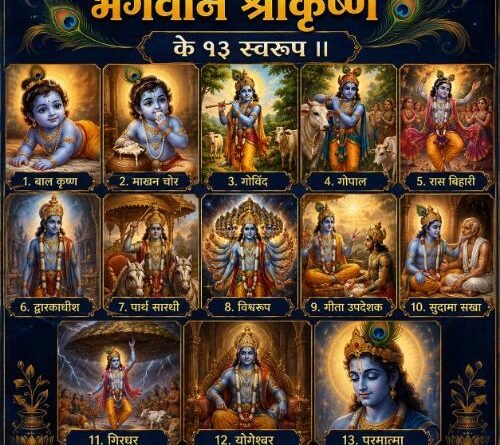
Lord Shri Krishna is considered a *Purnavatar* (a complete incarnation). Proficient in the sixty-four arts, Shri Krishna has left an indelible mark of his personality on every sphere. While Lord Shri Krishna manifests in hundreds of forms and hues, thirteen of his forms are presented here—
1. Child Krishna
Lord Shri Krishna was born under extraordinary circumstances, and thousands of books have been written about his childhood pastimes. Accounts of these childhood exploits are found in the *Shrimad Bhagavata Purana*. Krishna spent his childhood in Gokul and Vrindavan. Even as a child, he slew demons such as Tadaka, Putana, and Shakatasura. Child Krishna is also known as ‘Makhan Chor’ (the Butter Thief).
2. Gopal Krishna—
Lord Shri Krishna was a cowherd who used to graze cows; hence, he is also known as ‘Gopal’. A male cowherd is called a *Gop*, and a female cowherd is called a *Gopi*—though these terms have multiple meanings. The *Puranas* contain descriptions of the *Gopi-Krishna Leela* (divine play), in which the *Gops* and *Gopikas* perform the *Dandiya Raas* dance.
3. Krishna the Protector—
Lord Krishna slew formidable wrestlers like Chanura and Mushtika while still in his adolescence; furthermore, when the Braj region—including Vrindavan—faced a devastating deluge due to the wrath of Indra, He protected all the villagers by lifting Mount Govardhan upon His finger.
4. Krishna as a Disciple—
Lord Sri Krishna’s guru was Sandipani. His ashram was located in Avantika (Ujjain). It is said that Krishna also received knowledge from Neminathji, the 22nd Tirthankara of Jainism. As part of his *guru-dakshina* (offering to the teacher), Krishna brought back Sandipani’s deceased son after liberating him from the clutches of Yamaraj.
5. Krishna’s Companions—
Lord Shri Krishna had thousands of companions. ‘Sakha’ means a friend or associate. Krishna’s companions included Sudama, Shridama, Madhumangala, Subahu, Subala, Bhadra, Subhadra, Manibhadra, Bhoja, Tokakrishna, Varuthapa, Madhukanda, Vishala, Rasala, Makaranda, Sadananda, Chandrahasa, Bakula, Sharada, Buddhiprakasha, Arjuna, and others. Krishna also had thousands of female companions; notably, there were eight principal female companions, including Radha and Lalita.
According to the *Brahmavaivarta Purana*, the names of the *sakhis* (female companions) are as follows: Chandravali, Shyama, Shaivya, Padya, Radha, Lalita, Vishakha, and Bhadra. In some sources, the names are listed as: Chitra, Sudevi, Lalita, Vishakha, Champakalata, Tungavidya, Indulekha, Rangadevi, and Sudevi. Elsewhere, the list includes Lalita, Vishakha, Champakalata, Chitradevi, Tungavidya, Indulekha, Rangadevi, and Kritrima (Maneli). There are variations among these names. Additionally, all the women rescued from Bhaumasura were *sakhis* of Krishna. Draupadi was also a *sakhi* of Shri Krishna.
6. Krishna as a Lover—
Krishna had many *Gopis* and beloveds who adored him. Poets devoted to Krishna have accorded a prominent place in their poetry to the *Raas-lila* (divine dance) shared by Krishna and the *Gopis*. In the *Puranas*, the romantic relationship between Krishna and the *Gopis* is portrayed in both spiritual and highly erotic terms; while this spiritual dimension is absent from the *Mahabharata*, it is a key feature of the *Puranas*. Among his beloveds, Radha, Rukmini, and Lalita are the most frequently mentioned.
7. Krishna, the Karma Yogi—
Karma Yoga holds great significance in the Gita. Krishna regarded every action he undertook as his *Karma* (duty); to ensure the success of his endeavors, he employed all strategies—*Sama, Dama, Danda, and Bheda* (conciliation, inducement, punishment, and division)—because he lived fully in every sphere of life and discharged his responsibilities with complete commitment. His aim was not to dwell in the past or the future, but to live with absolute intensity in the present moment.
8. Krishna, the Embodiment of Righteousness (Dharmayogi)—
Lord Krishna, in collaboration with the sage Vedavyasa, accomplished a great deal for the cause of *Dharma* (righteousness). In the *Gita*, He declared that whenever *Dharma* declines, He will incarnate. Krishna played a pivotal role in re-establishing *Sanatana Dharma*.
9. The Warrior Krishna—
Lord Krishna did not fight in the Mahabharata war; he served as Arjuna’s charioteer. However, he did participate in at least ten battles. He engaged in fierce combat with Chanura, Mushtika, Kamsa, Jarasandha, Kalayavana, Arjuna, Shankara, Narakasura, Paundraka, and Jambavan.
He played a pivotal role in the Mahabharata war, serving as Arjuna’s charioteer. However, he is also known as ‘Ranchhod Krishna’—a name given to him because he left Mathura for Dwarka to protect his kinsmen. He did not want the members of his clan to engage in a futile war solely because of his enmity with Jarasandha.
10. Yogeshwar Krishna—
Lord Shri Krishna was a great Yogi. His body was extremely flexible, yet he could make it as hard as *Vajra* (thunderbolt) at will; furthermore, he possessed various yogic powers. It was through the power of Yoga that he maintained his youthfulness until the very end of his life.
11. Krishna as an Incarnation—
Lord Shri Krishna was an incarnation of Vishnu. He is considered a *Purnavatara* (a complete incarnation). During the Mahabharata war, by revealing His *Virat Swaroop* (Cosmic Form) to Arjuna, He demonstrated that He is indeed the Supreme God.
12. Krishna: The Statesman and Strategist—
Throughout his life, Lord Krishna shaped the future by molding circumstances to his advantage through the power of statecraft. Just as he orchestrated the donation of Karna’s *Kavacha* (armor) and *Kundala* (earrings), he simultaneously prevented Duryodhana’s entire body from becoming as impenetrable as *Vajra* (thunderbolt). On one hand, He demanded the head of the immensely powerful Barbarik, while on the other, He deployed Ghatotkacha into the battle at the opportune moment. There are hundreds of such instances that reveal the cunning strategy with which He orchestrated the entire Mahabharata and secured victory for the Pandavas.
13. Krishna’s Sincere Relationships—
Lord Krishna had eight wives: Rukmini, Jambavati, Satyabhama, Mitravinda, Satya, Lakshmana, Bhadra, and Kalindi. He had approximately eighty sons with them. Krishna had three sisters: Ekananga (Yashoda’s daughter), Subhadra, and Draupadi (a sister by bond). His brothers included Neminath, Balarama, and Gada. Krishna arranged Subhadra’s marriage to Arjuna, the son of his paternal aunt Kunti. Similarly, Shri Krishna arranged the marriage of his son Samba to Duryodhana’s daughter, Lakshmana. When it comes to Shri Krishna’s relationships, they were indeed very complex.