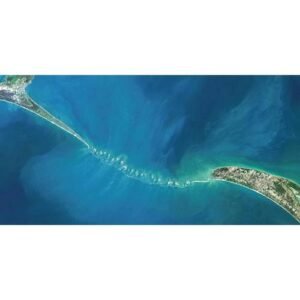



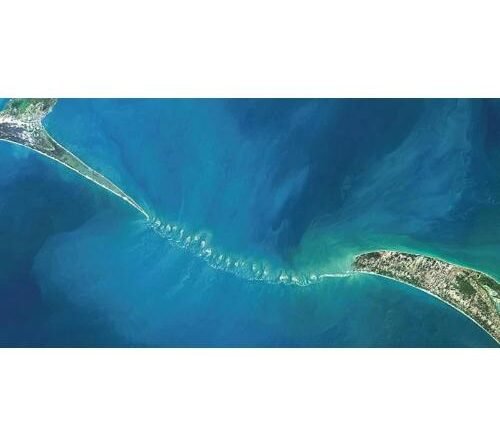
How was the stone bridge built in the sea……….???
There was silence in the royal court of Lanka. Ravana’s most astute spies, Shuka and Saran, arrived panting. They had just returned from aerial surveillance on the seashore. What they saw was beyond their imagination.
He bowed before Ravana and said, “Your Majesty! Those monkeys are planning to dam the ocean with stones.” Ravana laughed out loud. In his scientific view, this was physically impossible. But Ravana, immersed in ego, had forgotten that two great giants of ‘Material Science’, ‘Nal’ and ‘Neel’ were present in the enemy camp.
Ravana burst into laughter and said, “Stones can never float! This is against physics.” But he had no idea that on the banks of Rameswaram, Nala and Neel were rewriting the laws of nature.
There is a quatrain from Ramayana –
Nala brings Neela and the gods.
On the beach, Nala and Neel were checking the coding (writing the name Ram) and quality of the stones.
Nala and Neel had marked the stones in pairs. The alignment of the letters on the stones allowed the monkeys to determine which side would fit into which stone. If a stone was placed incorrectly, it would be out of alignment, which Nala could immediately recognize.
Sea waves can break down any wall. Nala-Neel used the Breakwater technique here. The bridge’s edges were sloped. When waves hit them, their kinetic energy was dissipated, and the bridge was not subjected to pressure.
The result: Whenever a sea earthquake or tsunami-like wave struck, the bridge absorbed the pressure and did not collapse. Today it is called ‘Base Isolation Technique’, which is used to protect skyscrapers from earthquakes.
Sea salt corrodes iron and ordinary stone. Nala and Neel chose limestone/pumice that had a high silica content. The silica reacts with the salt and hardens it. During construction, they used extracts of sea plants, which sealed the pores of the stones, preventing salt from reaching inside.
When the larger stones were joined together, tiny gaps remained between them. A group of tiny squirrels also gathered here. The squirrels’ entry was an engineering masterstroke. Aggregate filling was crucial. The sand brought by the squirrels filled the cracks. This increased the bridge’s load-bearing capacity many times over. The sand particles created friction between the stones, preventing even the strongest waves from shaking the bridge. This was not only devotion but also the final stage of ‘Precision Engineering’.
The reason why chants of “Jai Shri Ram” were heard during the bridge’s construction wasn’t devotion, it was part of science. Nala and Neel set the stones with “vibrational tuning.” When the monkeys chanted ‘Jai Shri Ram’ together, the sound waves activated the tiny air bubbles present between the stones. It was similar to what scientists today call ‘Acoustic Levitation’ (making objects float in the air with the help of sound).
Nala and Neela didn’t just throw stones into the water, Instead, they were held in vibrational balance. When the army chanted the name “Rama” collectively, the vibrations drew the stones closer together. Modern science calls this “sonic bonding.”
Night surveillance was in place at the time. Ravana’s spies noticed that the bridge glowed even in the dead of night. In fact, Nala and Neel had applied a coating of bioluminescent seaweed so that construction could continue even in the dark of night.
A five-day miracle became history. Fast-track project management was implemented. It was the fastest construction in history. Nala and Neel presented a remarkable example of division of labor. Day 1: 14 yojanas (foundation and initial structure).
Day 2: 20 Yojanas (entry into deep water and alignment of stones).
Day 3: 21 Yojanas (checking the stability of the bridge).
Day 4: 22 Yojanas (construction and coating of the upper road).
Day 5: 23 Yojanas (reaching the end and load testing).
As the sun set on the fifth day, the bridge was complete. The monkey army’s enthusiasm was at its peak. The sea, once a barrier, had now become a highway. A grand confluence of knowledge, science, and faith.
Rama Setu was not just a collection of stones. This was the confluence of ‘Hydraulics’ (Hydraulics – Science of Water Power), ‘Oceanography’ (Oceanography – Science of Oceanography) and ‘Acoustics’ (Acoustics – Science of Sound) which even a great scientist like Ravana was astonished to see.
When Mandodari saw that bridge, she said to Ravana:-
The Lord who gave them sand came home.”
As Ravana passed over it in his ‘Pushpaka Vimana’ (Pushpak Vimana), he was stunned to see the bridge from an engineer’s perspective.
Seeing the apes everywhere, Ravana felt great pain in his heart.”
“Bandho Setu Neel Nala Nagar”: Ravana saw that the clever (Nagar) Nala and Neel had built a bridge over the sea.The word ‘Nagar’ here means ‘skilled’ or ‘Professional Engineers’.
“Ram Kripaan Jas Bhayu Ujaagar”: This bridge was spreading the fame of Lord Ram’s grace and his valor all around.
“Jahan tahan dekhi kapin ka bhira”: Ravana was astonished to see a huge army (crowd) of monkeys moving here and there on that bridge.
“Ravana hridayam bhaai ati peera”: Seeing this scene, Ravana felt ‘ati peera’ (extreme pain and fear) in his heart.
He felt that Lanka’s “invulnerability” had been destroyed by Nala-Nile’s “geometric precision.” It was a science-driven confrontation between an Advanced Stealth Vehicle (Pushpak) and a Solid Logistics Link (Setu).
Ravana stabilized the plane in the sky. Pushpak’s Mercury Vortex Engine powered it to hover. From there, Ravana observed the bridge’s geometrical precision and was astonished. As a great scientist, he understood that this was not just a play, but the ultimate science.
Until now, Ravana had considered this merely a rumor from his spies. But when he saw the 30-mile-long route with his own eyes, his logistical confidence was shattered. He realized that the sea was no longer the moat protecting Lanka, but had become the enemy’s highway.
Ravana was not physically injured, but his intellectual superiority was deeply hurt. He considered himself the greatest architect and wisest, but two monkeys (Nala and Neela) accomplished something Ravana had never imagined.
Ravana saw that the bridge was so strong that it could easily support the weight of millions of monkeys. This was a living proof of the bridge’s load-bearing capacity.