


Chandra Sarovar of Vrindavan
Long ago, in the sacred forests of Vrindavan, Sri Radha and Krishna performed a divine springtime Raas-lila with the gopis in a secluded grove near Govardhan. Unlike the famous Raas-lila at Radha-kunda, this dance was performed on a moonlit night in the open fields of the forest—there was no lake at that time, only soft dust, flowering trees, and divine melodies wafting through the air.
That night was filled with the fragrance of blooming flowers. Bumblebees hummed, the air was filled with the scent of sandalwood and lotus, and the gopis, adorned in beautiful clothes and garlands, danced in perfect harmony with their beloved Shri Krishna, whose flute’s tune resonated with the heart of the entire universe.
A host of gods hovered above this heavenly dance, unable to resist its fascination. Mounted on their celestial planes, they watched the spectacle with reverence and awe. Among them was Lord Chandra himself. That night, he had the unique privilege of spreading his cool moonlight over the dancing circle of Radha, Krishna, and the gopis.
Initially, Chandradev merely performed his duty—to shine, radiate light, and receive praise. But as the night progressed and the Raas began to expand into deeper expressions of love, something began to change in Chandradev’s heart. The sweetness of Sri Krishna’s smile, Srimati Radha’s loving glances, and the joyful footsteps of the gopis—all of this filled Chandradev’s heart with profound spiritual emotion.
Suddenly, as if unable to bear the rising tide of ecstasy, Chandradev began to weep. These were not tears of sorrow, but of ecstasy and divine wonder—tears that come only when one directly witnesses the Lord’s most secret pastimes. His tears fell—not symbolically, but literally, like showers of cool nectar falling from the sky.
And what happened next was a miracle.
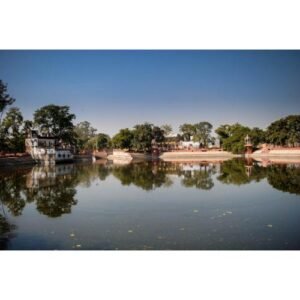
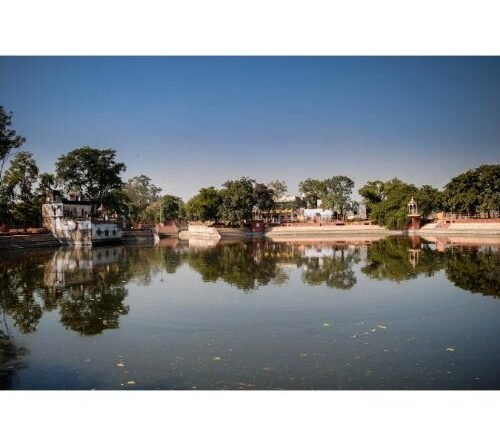
Those tears fell in such abundance that the forest floor began to absorb them. Drop by drop, stream by stream, the forest floor gradually filled with these tears, until a beautiful lake appeared at the very spot of the Raas Leela. That lake came to be known as ‘Chandra Sarovar.’