






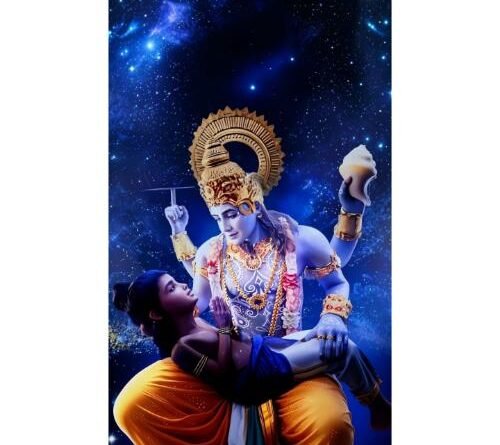
Five Deceptions Performed by Lord Vishnu for the Welfare of the World!!
In Hinduism, it is said that Lord Brahma is the Creator, Lord Vishnu is the Preserver, and Lord Shiva is the Destroyer (the one who withdraws life). Lord Vishnu is the sustainer of the universe; He alleviates everyone’s suffering and bestows the boon of an excellent life. Whether one faces a personal crisis or a calamity arises on Earth, it is Lord Vishnu who finds the solution and resolves the issue.
It was Lord Vishnu who, by incarnating as Narasimha, saved His devotee Prahlad and liberated the people from the cruel Hiranyakashipu. Similarly, by taking the Varaha avatar, He slew the terrifying Hiranyaksha and freed the gods, humans, and all other beings from fear. It was He who protected the gods from the mighty and cunning King Bali.
Similarly, Shri Hari Vishnu performed certain acts that were described as deceptions undertaken for the welfare of the people. Had He not done so, the lives of many gods and goddesses would have been in peril.
⭕ Deceiving Bhasmasura – Hearing the name Bhasmasura likely brings his story to mind for everyone. Lord Shankar’s life was once imperiled because of Bhasmasura. Although he originally had a different name, he came to be known as Bhasmasura because he had received the boon to reduce others to ashes.
Bhasmasura was a supremely wicked demon. To increase his power, he performed intense penance to Lord Shiva and sought the boon of immortality; however, Lord Shiva asked him to choose something else instead. Bhasmasura then requested a boon whereby anyone upon whose head he placed his hand would be reduced to ashes. Lord Shiva said, “So be it.”
As soon as he received the boon, Bhasmasura said, “Lord, why not test the power of this boon?” He then rushed to place his hand upon Shiva’s head. Shiva fled the scene and sought refuge with Vishnu. Vishnu then assumed the form of a beautiful woman to captivate Bhasmasura. Bhasmasura forgot about Shiva and became enchanted by the beautiful woman. Vishnu, in the guise of the alluring woman, invited Bhasmasura to dance with her, and he readily agreed.
While dancing, Bhasmasura began to mimic Mohini’s movements; seizing the opportune moment, Lord Vishnu placed His hand upon His own head. Bhasmasura, intoxicated by power and lust, imitated the gesture and was reduced to ashes by the very boon he had obtained.
This is where Shiva hid—Lord Shankar fled to escape Bhasmasur, who pursued him. While fleeing, Shiva stopped near a hill, carved a cave into it using his trident, and hid inside. Later, Lord Vishnu arrived and saved him. It is believed that this cave is located in the Trikuta Hills, 150 kilometers from Jammu. The mere sight of these beautiful hills brings a sense of peace to the mind. Every day, hundreds of devotees visit this cave to worship Lord Shiva.
⭕ Deception of Vrinda – According to the *Shrimad Devi Bhagavata Purana*, the demon Jalandhara was an embodiment of a part of Shiva, though he was unaware of this fact. Jalandhara was an immensely powerful demon. Having defeated Indra, he had become the ruler of the three worlds; even Yama feared him.
According to the *Shrimad Devi Bhagavata Purana*, Lord Shiva once cast his divine energy into the ocean, giving rise to Jalandhara. Jalandhara was believed to possess immense power, a strength derived from his wife Vrinda’s unwavering devotion and chastity. Even the combined might of all the gods and goddesses could not defeat him, as long as Vrinda upheld her vow of marital fidelity. Emboldened by his invincibility, Jalandhara became arrogant; disregarding Vrinda’s virtuous devotion, he turned against the gods and began tormenting their wives.
Jalandhar knew that if there was anyone truly the most powerful in the universe, it was Mahadev—the God of Gods. To establish himself as the supreme power, Jalandhar first defeated Indra and became the ruler of the three worlds. Subsequently, he launched an attack on Vishnu Loka.
Jalandhar devised a plan to defeat Vishnu and wrest Goddess Lakshmi from him. Consequently, he attacked Vaikuntha; however, Goddess Lakshmi told Jalandhar that since both of them had originated from water, they were siblings. Impressed by her words, Jalandhar accepted Lakshmi as his sister and departed from Vaikuntha.
Subsequently, he devised a plan to attack Kailash; gathering all his Asuras, he marched there and attempted to make Goddess Parvati his wife. This enraged Goddess Parvati, compelling Mahadev to engage in battle with Jalandhar; however, thanks to the power of Vrinda’s chastity, Jalandhar was able to nullify every strike launched by Lord Shiva.
Finally, the gods devised a plan, and Lord Vishnu, assuming the guise of Jalandhar, approached Vrinda. Mistaking Lord Vishnu for her husband Jalandhar, Vrinda began to treat him as a wife would her husband. This act caused her vow of marital fidelity to be broken, and Shiva subsequently slew Jalandhar.
Upon the violation of her chastity by Vishnu, Vrinda immolated herself; a Tulsi plant sprouted from her ashes. Goddess Tulsi is an embodiment of Vrinda herself, whom Lord Vishnu cherishes even more than Lakshmi.
The present-day city of Jalandhar in the Indian state of Punjab derives its name from Jalandhar. Even today, a temple dedicated to Devi Vrinda—the wife of the Asura king Jalandhar—stands in the Mohalla Kot Kishanchand area of the city. It is believed that an ancient cave once existed here, leading directly to Haridwar. Legend has it that in ancient times, there were twelve ponds surrounding the city, and boats were required to access it.
⭕ Deceiving the Asuras by assuming the form of Mohini – When Indra was defeated in battle by Bali, the king of the Daityas, the disheartened and dejected gods approached Lord Vishnu for refuge, accompanied by Lord Brahma, and prayed to Him to help them regain their celestial abode, Swargaloka.
Sri Hari advised all the gods to reconcile with the demons and, with their cooperation, churn the Ocean of Milk using Mount Mandara as the churning rod and the serpent Vasuki as the rope. He promised to make all the gods immortal by feeding them the nectar obtained from this churning; only then would the gods be able to destroy the demons and regain dominion over heaven.
Indra, the king of the gods, approached Bali, the king of the demons, and proposed the churning of the ocean, revealing the existence of *Amrit* (the nectar of immortality). Tempted by the prospect of obtaining the nectar, the demon agreed to join forces with the gods. The gods and demons exerted all their strength in an attempt to lift Mount Mandara and carry it to the seashore but failed to do so; eventually, Shri Hari lifted the mountain and placed it into the ocean.
The auspicious task of the churning of the ocean began, using Mount Mandara as the churning rod and the serpent Vasuki as the rope. Lord Vishnu noticed that the churning rod was sinking downwards; observing this, He Himself assumed the form of a tortoise and supported Mount Mandara on His back.
Subsequently, the *Samudra Manthan* (Churning of the Ocean) yielded Lakshmi, Kaustubha, Parijata, Sura, Dhanvantari, the Moon, Pushpaka, Airavata, Panchajanya, the conch shell, Rambha, Kamadhenu, Uchchaihshravas, and finally the pitcher of *Amrit* (nectar of immortality), which Dhanvantari brought forth. The *Daityas* (demons) snatched the pitcher of nectar from his hands and fled, intending to consume it before the *Devatas* (gods) and thereby attain immortality. A dispute broke out among the demons over the pitcher, while the gods stood by in despair.
Lord Vishnu assumed the form of an exquisitely beautiful woman and appeared before the gods and the demons, proposing to distribute the nectar equally among them. Enchanted, the demons handed over the pitcher of nectar to Lord Vishnu. Vishnu, in the guise of Mohini, declared that she would undertake the task of distribution only if they promised not to interfere, regardless of whether the method she employed was deemed fair or unfair.
Everyone accepted the words of the Lord, who had assumed the form of Mohini. The gods and the demons sat in separate rows. Assuming the guise of Mohini, Vishnu deceitfully served all the nectar to the gods, but this sparked immense outrage among the demons.
The Deception of King Bali—Bali, the king of the Asuras, is frequently mentioned in the Puranas. Although he possessed immense power, he was a righteous soul who never hesitated to engage in acts of charity and benevolence. His greatest flaw, however, was his arrogance regarding his own powers; he considered himself equal to the Divine and was a staunch adversary of the Devas. Hiranyakashyap and Hiranyaksha were the two prominent sons of Sage Kashyapa’s wife, Diti. Hiranyakashyap had four sons: Anuhallad, Hallad, Bhakta Prahlad, and Samhallad. King Bali, the son of Virochana, was born into Prahlad’s lineage.
King Bali’s kingdom spanned the entirety of South India, and he had established Mahabalipuram as his capital. Even today, the festival of Onam is celebrated in Kerala in his memory. Aspiring to conquer the world, King Bali performed the Ashwamedha Yajna, a ritual that caused his fame to spread far and wide. Having successfully conducted 98 sacrifices—including the Agnihotra—and witnessing the continuous expansion of his kingdom and power, he resolved to invade Indra’s realm.
Thus, King Bali announced his ninety-ninth *Yajna* and sent invitations to all the kingdoms and their citizens. While the Gandharvas and Yakshas stood with the Devas, the Danavas and Rakshasas sided with the Daityas. In the final conflict, Indra fought against Prahlada—the son of Hiranyakashipu—and his son, King Bali; the Devas were defeated, and the Asuras came to rule over the entire Jambudvipa.
⭕ The Need for the Vamana Avatar – Vamana was the son of the sage Kashyapa and his wife Aditi. He was the twelfth among the Adityas. It is believed that he was the younger brother of Indra and the half-brother of King Bali. Lord Vishnu incarnated in this very form. The gods were unable to defeat Bali; he had allotted them only enough land to perform their *yagnas* (sacrificial rituals). Consequently, the gods sought refuge in Vishnu. Vishnu acknowledged that Bali, too, was his devotee, yet he promised to devise a strategy to resolve the situation.
Vishnu was then born to Aditi; one day, while Bali was planning a *yajna* (ritual sacrifice), Vishnu arrived there in the guise of a Brahmin to seek a donation. Shukracharya recognized Him the moment he saw Him. He immediately told Bali that the visitor was Vishnu and warned him not to donate anything without consulting him first. However, Bali disregarded Shukracharya’s advice and, when Vamana asked for a donation, granted Him three paces of land.
Once the ceremonial offering involving water had been made and everything donated, Lord Vamana—disguised as a Brahmin—revealed His cosmic form. The Lord measured the entire earth with a single stride. With the second, He spanned the heavens, and for the third, He asked Bali where He should place His foot.
When asked, Bali smiled and said, “The shortcoming lies in the very way You created the world; what can I do, Lord? Now, only my head remains.” Thereupon, Vishnu placed His third foot upon Bali’s head. Pleased by his devotion, Vishnu granted him the boon of reigning as the king of Rasatala—in the netherworld—until the end of the Kali Yuga. Bali then sought one more boon from Vishnu.
King Bali said, “Lord, if You are indeed making me the ruler of Patala Loka, then grant me the boon that my kingdom remains safe from the machinations of enemies and that You stay with me.” Acceding to His devotee’s request, Lord Vishnu resolved to reside in King Bali’s abode.
In the kingdom of Patalpuri, Lord Vishnu remained physically present around the clock to protect King Bali; thus, Bali could sleep without a care, while—alongside Shukracharya—he administered a new righteous order across the entire realm.
⭕ A Ruse Played on Goddess Parvati – It is believed that Badrinath Dham was once the resting place of Lord Shiva and Goddess Parvati. Lord Shiva used to reside here with his family, but Lord Vishnu (Sri Hari) was so captivated by the place that he devised a plan to acquire it.
According to ancient legend, when Lord Narayana arrived at Badrinath during the Satya Yuga, the area was a forest of *Badri* (jujube) trees, and Lord Shankar was living there happily with his consort, Parvati.
One day, Shri Hari Vishnu assumed the form of a young boy and began to cry loudly. Hearing his weeping, Mother Parvati was deeply distressed. She wondered, “Who is this child crying in this desolate forest? Where has he come from?”
And where is his mother? Thinking of this, the mother felt compassion for the child. She then took the child home with her. Lord Shiva immediately understood that this was a divine play of Lord Vishnu. He urged Parvati to leave the child outside the house, saying that he would cry for a while and then leave on his own.
However, Mother Parvati did not heed his words; instead, she took the child inside, soothed him, and put him to sleep. Shortly after the child fell asleep, Mother Parvati stepped out and went for a stroll with Lord Shiva. Lord Vishnu had been waiting for this very moment; he rose and closed the door of the house.
When Lord Shiva and Parvati returned home, the door was bolted from the inside. When they asked the boy to open the door, Lord Vishnu spoke from within, saying, “Forget it now, O Lord. I have taken a great liking to this place.”
“Let me rest right here. You may now proceed to Kedarnath from here.” Since then, Badrinath has been granting darshan to His devotees here, while Lord Shiva grants darshan at Kedarnath!
!!Hari Om!!