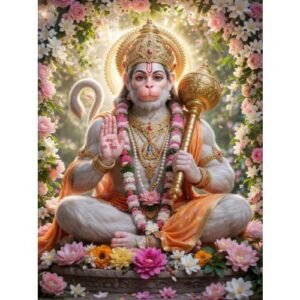



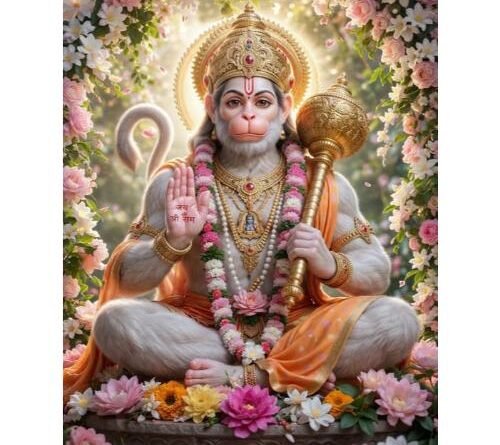
It is said that wherever the name of Ram is mentioned, Hanuman comes there even today.
It is said that wherever Ram’s name is mentioned, Hanuman still comes. He sits quietly, at the back, wipes his tears, and leaves.
I thought it was a story until I saw it for myself.
Sunderkand is recited every Tuesday at our house. Grandma’s tradition. Since 1982. Lucknow, Chowk Wali Gali. Small courtyard, carpets spread, dholak, manjira. 15-20 people.
Grandma would say, “Keep the space empty, just one.” We would ask, “For whom?” She would say, “For those who come uninvited.”
I laughed. Grandma passed away in 2023. She was 89 years old. Last Tuesday, she played the cymbals. Before she died, she said, “Don’t stop reciting the Sunderkand. He’s coming.”
We continued. Dad, Mom, and me.
Last year, July. Rain. Few people came. Only nine. I left the same spot at the end of the carpet empty, where Grandma used to be.
The recitation began. “Atulit Bal Dhamam…”
Just then, an old man appeared at the door. He was drenched. Around 70-75 years old. He had a muscular body, a dhoti that reached his knees, and a towel over it. His beard was white, his eyes red, as if he had cried. He had nothing in his hand.
Mother said, “Dad, come in.”
He said nothing. He took off his shoes outside and sat down in the empty space at the back. He bowed his head.
We recited the prayer. When “Jamvant ke Vachan Suhaaye” came on, tears started flowing from his eyes. Silently. He didn’t wipe them.
I noticed his hands were large, veins bulging, his nails broken, as if he had lifted mountains.
The Aarti was performed. Everyone received prasad. I gave him two laddus. He took one and returned the other. He said softly, “One is enough.”
I asked, “Baba, where did you come from?”
He smiled, “Wherever Lord Ram calls me.”
“Name?”
He said, “Das.”
He got up and started to leave. I said, “It’s raining, stop.”
He said, “The one whose name you mentioned is the roof.”
He left.
He came again the next Tuesday. This time earlier. The same place. This time he wasn’t wet, but his eyes were still red.
When “Vibhishana accepted your mantra” came up in the lesson, he started to tremble slightly. As if someone had placed a hand on his chest.
Papa later asked, “Why does this Baba cry every time?”
I noticed. He never clapped, never sang. He just listened. And when the name “Ram” came up, his breathing quickened.
On the third Tuesday, I came early. I thought I’d talk to him. He was already sitting. I asked, “Baba, you seem to be a devotee of Hanumanji.”
He looked at me. There was such a radiance in his eyes that I bowed down. He said, “Not a devotee, but a servant. A devotee asks, a servant listens.”
I asked, “What do you want?”
He laughed, “The same thing I’ve been asking for for 5000 years: to hear his name again.”
I thought he was crazy.
That night I found Grandma’s old diary. It was from 1998. It was written, “Today an old man came to Sunderkand. He sat at the back. He cried a lot. When I offered him Prasad, he said, ‘Mother, your voice is sweet. Just like Mother Sita used to sing.’ I asked who he was, and he said, ‘The watchman of the Ram Katha.’ I looked at his feet; they weren’t dusty, even in the rain.”
My heart skipped a beat.
On the fourth Tuesday, I decided. I would see his feet.
The recitation began. The electricity went out. A candle was lit. In that light, I saw him. He was sitting, but his shadow seemed large on the wall. As if he was standing, not sitting. There was no tail-like structure, but his shoulders were broad and bent, as if he was carrying a weight.
After the Aarti, everyone left. He stopped. He came to me. He placed his hand on my head. His hand was heavy and warm. He said, “Your grandmother kept the place vacant, and you did too. That’s why I came.”
I asked, “Who are you? Tell me the truth.”
He went to the door. Turned. Said, “Wherever the Ram Katha is left incomplete, I come to listen to it completely. Wherever someone cries with love, I come to wipe away their tears. Don’t ask my name. If you call me, I’ll leave.”
And he left. The rain was heavy again. I looked outside; no one was in the street. No footprints.
He didn’t come the next Tuesday. Not even after that.
I felt sad. Mother said, “Maybe he’s gone somewhere else.”
On Diwali, we held a big Sunderkand recitation. 50 people. Panditji came. The recitation began. Crowded. No space.
Just then, the same old man stood at the door. This time, in a clean dhoti, no towel, and a red choli. Not wet. He was smiling.
I ran and made room, the one at the back. He sat down.
When “Siyavar Ramchandra ki Jai” was recited, everyone stood up. He stood up too. The lights came on at that moment. I saw clearly in the tubelight, his eyes closed, tears on his cheeks, and a slight smile on his lips, as if he had returned home after years.
After the Aarti, I tried to touch his feet. He stopped me. He whispered in my ear, “Don’t touch my feet. Listen to the story. I live in the story, not in my feet.”
And he left.
That night, I lit a lamp in front of my grandmother’s photo. I understood.
We look for Hanuman in temples, in idols, in vermillion. But he doesn’t live where there’s noise. He lives where an old woman cries while playing her cymbals, where a mother puts one extra laddu in the prasad, where a space is left empty.
He still comes today. Quietly. Without a bell. Without a crowd.
If you want to recognize him, look at the one who sits at the back, who doesn’t sing, but only listens, whose eyes fill with tears at the mention of Ram’s name, who takes only one laddu as prasad, and doesn’t bless him when leaving, but simply places a hand on his head.
He is the one.
A carpet is still spread in our house every Tuesday. And one spot remains empty.
Because we know someone comes. Silently. Listens. Weeps. And reassures us that the story of Rama is never alone.
Hanuman still comes. We just need eyes to listen.