






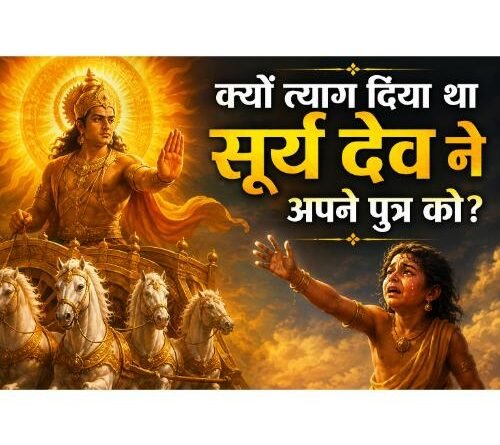
Why did the Sun God abandon his son?
This question is not merely about a story; rather, it involves a profound exploration of righteousness (*Dharma*), divine radiance (*Tej*), ego, and the father-son relationship. The Sun God had several sons—Vaivasvata Manu, Yama, Shani, the Ashwini Kumars, Sugriva, and Karna. However, the narrative of sacrifice is primarily associated with two of them: Shani Dev and Karna. While the reasons for their respective sacrifices differ, the underlying elements remain the same—social propriety, the formidable nature of divine radiance, and the dictates of destiny (*Prarabdha*).
1. First Story – The Story of Shani Dev’s Renunciation
According to the Puranas, Surya Dev was married to Sanjna, the daughter of Daksha Prajapati. Sanjna was immensely radiant and devoted to her husband. They had three children together: Vaivasvata Manu, Yama, and Yamuna.
However, Sanjna could not endure the unbearable radiance of the Sun God for long. His brilliance was as intense as fire, making it difficult even to look at him. Sanjna thought that if she went away for a while to perform penance, her own radiance would increase, enabling her to withstand the Sun’s brilliance.
With this in mind, Sanjna created a woman from her own shadow. She was named Chhaya. Chhaya was a replica of Sanjna, yet her temperament differed from hers. Sanjna instructed Chhaya to assume her role in the Sun’s household during her absence, to nurture her children, and to ensure that the Sun God remained unaware of her departure. Sanjna herself went to her father’s home and subsequently traveled to the region of Uttarakuru, where she assumed the form of a mare and engaged in penance.
Chhaya obeyed Sanjna’s command. The Sun God could not detect Chhaya’s deception, as she was formed from a part of Sanjna herself. In time, Chhaya bore three children to the Sun God: Savarni Manu, Shani, and a daughter named Tapati.
Chhaya was very affectionate towards her children, whereas she showed some harshness towards Sangya’s children. Once, the boy Yama felt hungry. Chhaya delayed serving the food. Enraged, Yama raised his foot to kick Chhaya. Angered by this, Chhaya cursed Yama, saying that his foot would break.
Yama went to the Sun God, weeping. Upon witnessing his wife’s harsh behavior, the Sun God grew suspicious. He looked with his inner vision and discovered the truth: it was not Sanjna, but Chhaya. The Sun God became furious and set out to find Sanjna.
When the Sun God reached Uttarakuru in his search for Sangya, he found her performing penance in the form of a mare. He, too, assumed the form of a horse and united with her. From this union, the Ashwini Kumars were born; they later became the physicians of the gods.
After this, the Sun God placated Sanjna and brought her back to his realm. He asked Chhaya to reveal the truth. Now, the matter concerning Shani remained.
Shani was born of Chhaya. While Shani was still in the womb, Chhaya remained constantly immersed in severe penance for Lord Shiva, enduring the scorching radiance of the Sun God and the sorrow of separation from Sanjna. She performed this penance while sitting in the blazing sun, without food or water. This penance, the lack of radiance, and the neglect deeply affected Shani as he developed in the womb. Consequently, when Shani was born, his complexion was dark—black. His physique was not devoid of luster; rather, it possessed a profound and solemn gravity.
When the Sun God—himself the embodiment of radiance—beheld his newborn son, whose complexion was dark, doubt arose in his mind. Light always perceives a contrast with darkness; thus, the Sun God suspected Chhaya, believing the child could not be his own. This stemmed from his ego and the arrogance born of his own brilliance.
He insulted Chhaya and refused to acknowledge Shani as his son. This was the first moment of abandonment. The Sun God rejected the son born of his own radiance solely because of his complexion.
Chhaya could not bear this insult. Shani, who had been witnessing the humiliation of his mother while still in the womb, cast an angry gaze upon his father, Surya Dev. It is said that Shani’s gaze possesses such power that anyone upon whom it falls loses their radiance. As Shani’s gaze fell upon him, Surya Dev’s brilliance dimmed, his chariot came to a halt, his horses stopped in their tracks, and he himself experienced agony akin to that of leprosy.
Then Lord Shiva intervened. He explained to the Sun God that Shani was indeed his own son. He pointed out that the son’s dark complexion was the result of his own penance and Chhaya’s rigorous vow, and that Chhaya was not at fault for it. He further stated that abandoning a son based on his complexion was an act of *adharma* (unrighteousness).
It was then that the Sun God realized his mistake. However, it was already too late. The love Shani ought to have felt for his father had transformed into a commitment to justice. Shani resolved never to reside in his father’s abode; instead, he moved far away from the Sun, performed penance near Kashi, and became the God of Justice. Even the Sun God accorded Shani a place among the *Navagrahas* (the nine celestial bodies), yet the rift between father and son was never bridged. This distance was not physical, but ideological; the Sun represents the light that reveals everything, while Shani embodies darkness and justice—seeing deep into the very core of things.
That is why it is said that Shani bears no enmity towards his father, Surya, yet neither does he hold a neutral stance. This estrangement was the result of Surya’s arrogance.
2. The Second Story – The Tale of Karna’s Sacrifice
The second—and most renowned—tale of sacrifice is that of Karna. This sacrifice was necessitated by circumstances.
When Kunti was still a maiden, the sage Durvasa had granted her a boon: whichever deity she invoked, she would be blessed with a son born of that deity’s essence. Out of curiosity during her youth, Kunti decided to test the efficacy of this mantra.
She invoked the Sun God. Through the power of the mantra, the Sun God appeared. He declared that the mantra could not go in vain and that she would bear a son. Kunti was frightened, as she was unmarried. She prayed to the Sun God. He assured her that after the birth of the son, her virginity would be restored, and she would face no public censure.
In due course, Kunti gave birth to a son who was adorned with armor and earrings. He was radiant like the sun. This was Karna.
However, at that time, Kunti was the daughter of the Yaduvanshi King Shurasena and was being raised in the household of Maharaja Kuntibhoja. Driven by the fear of society and public censure, Kunti decided to abandon the newborn infant. She placed him in a casket and set it afloat on the Ashwa River. The casket drifted as far as the city of Champa, where the charioteer Adhiratha and his wife Radha raised the child.
Now the question is, why did the Sun God abandon his son?
Lord Surya is a deity. Deities do not directly interfere with the ordained course of destiny. Lord Surya knew that Karna was born for a specific purpose: he would be renowned for his unparalleled generosity and valor, yet his life would be fraught with struggle. Had Lord Surya appeared at that very moment to acknowledge Karna as his son—thereby saving Kunti from public scandal—the crucial role Karna was destined to play in the Mahabharata would have remained unfulfilled; a role that required him to stand on the side of *Adharma* (unrighteousness) so that the significance of *Dharma’s* (righteousness) ultimate victory could be truly established.
The second reason lies in divine propriety. Although the Sun God had granted a boon to Kunti, He was under no obligation to explain the situation to her father or society. It was destined that Karna would be raised in the household of a *Suta* (charioteer), causing him to endure the humiliation of being called a *Suta-putra* throughout his life—an indignity that ultimately drew him to Duryodhana. Had the Sun God claimed Karna right from the start, Karna would not have had to traverse this particular life journey, and the balance of the Mahabharata would have been disrupted.
Thus, the Sun God’s act of letting go was not an expression of indifference, but rather an acceptance of the need to let destiny take its course. Nor did he ever truly abandon Karna. When Karna was deceived by Indra during the war and his *Kavacha* and *Kundala* (armor and earrings) were sought as a gift, the Sun God had already warned him in a dream. He issued a warning again when Karna was setting out for the final battle. As a father, the Sun God always stood by Karna, yet as a deity, he could not interfere with his destiny.
Conclusion
Thus, the Sun God’s renunciation of his son is viewed in two ways.
In the case of Shani, this renunciation stemmed from arrogance, caste-based discrimination, and a lack of trust—actions for which the Sun God had to atone, resulting in a permanent, formal distance between father and son.
In Karna’s case, this act of renunciation was dictated by social norms and the decrees of destiny. It was an act born of compulsion, not of detachment. The Sun gave birth to a son, yet society branded him a *Suta-putra* (charioteer’s son).
Both stories teach us that being the son of a radiant father is no easy matter. If a father’s radiance exceeds the bounds of moderation, it can scorch the son. That is why the Sun had to maintain a distance from his sons—from one, to establish justice; from the other, to establish righteousness.