






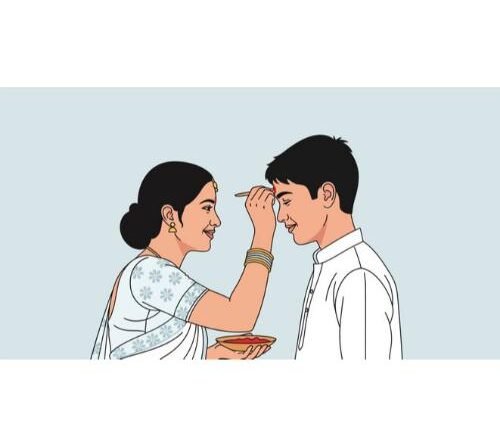
Why do Hindus apply a tilak on their forehead? Learn the scientific reason behind it!!!
The true identity of Hindu spirituality is the tilak. It is believed that wearing the tilak always elevates the mind and brings pride to society. Hindu families have a tradition of applying the tilak or teeka during any auspicious occasion. This tilak is applied with many objects and substances. Among these, turmeric, vermilion, saffron, ashes, and sandalwood are prominent. But do you know the underlying sentiment behind this tilak?
Perhaps, the practice of applying tilak on the forehead is not prevalent anywhere else except in India. This custom is very ancient. It is believed that Lord Vishnu resides in the center of a person’s forehead, and the tilak is applied precisely at this spot.
The Puranas state that applying a tilak (a mark of the forehead) after bathing in the Ganges at the Sangam (confluence) leads to salvation. This is why the Pandas apply a special tilak to their devotees after bathing. There is spiritual significance behind applying a tilak to the forehead.
Its scientific significance:
In fact, our bodies contain seven subtle energy centers, which are reservoirs of immense power. These are called chakras. The Agya Chakra is located in the center of the forehead, where we apply the tilak. This chakra is the most important point in our body, where the three main nerves (Ida, Pingala, and Sushumna) meet, hence it is also called Triveni or Sangam.
This is called the Guru Sthan (the place of the Guru). It is the center of all our body’s operations. It is also the seat of our consciousness. It is also called the home of the mind. For this reason, this is the most revered place in the body. In yoga, the mind is concentrated here during meditation.
The spot in the middle of the forehead where the mark or tilak is applied is the Agya Chakra. Anatomically, this is the location of the pineal gland. When the pineal gland is stimulated, a kind of light is felt within the brain. This has been proven by experiments. Our sages knew very well that stimulation of the pineal gland will stimulate the Agya Chakra.
For this reason, the practice of applying Tilak in religious rituals, worship and auspicious functions is followed so that by its repeated stimulation, the gross and subtle nerves in our body can be awakened. In this easy way, the interest of the general public is drawn towards religion, towards spirituality, and after knowing the third eye, efforts are made towards its development, due to which the Agya Chakra gets regular stimulation.
Women wear a red kumkum tilak (a mark of vermillion). This is not without purpose. The color red symbolizes energy and vitality. Tilak enhances a woman’s beauty. Applying a tilak is also associated with the worship of the Goddess. After worshipping the Goddess, the tilak is applied to the forehead. It is considered a symbol of the Goddess’s blessings.
The Importance of Applying a Tilak:
Applying a Tilak improves one’s temperament and has a positive effect on the beholder. If the body needs the substance used for the Tilak, it also fulfills that need.
Tilak is also applied for some special purpose, like if one wants to attain salvation then Tilak is applied with the thumb, if one wants to destroy the enemy then it is applied with the index finger, for getting wealth it is applied with the middle finger and for getting peace it is applied with the ring finger.
Tilak is usually applied with the ring finger, and only sandalwood is used. Applying rice with the tilak has the hidden purpose of attracting Goddess Lakshmi and providing coolness and purity. Therefore, everyone should definitely apply the tilak.
According to beliefs, a bare forehead is not considered auspicious. A tilak of sandalwood, roli, kumkum, vermilion or ash is applied on the forehead. Tilak serves as an identity mark in Hindu culture. Applying tilak is not only a religious belief but also has many scientific reasons.
In Tantra Shastra, applying tilak made of Panch Gandh or Asht Gandh has great significance. In Tantra Shastra, it has been said to apply tilak on thirteen parts of the body, but the brain controls the entire body. Therefore, the tradition of applying tilak on this part is more popular.